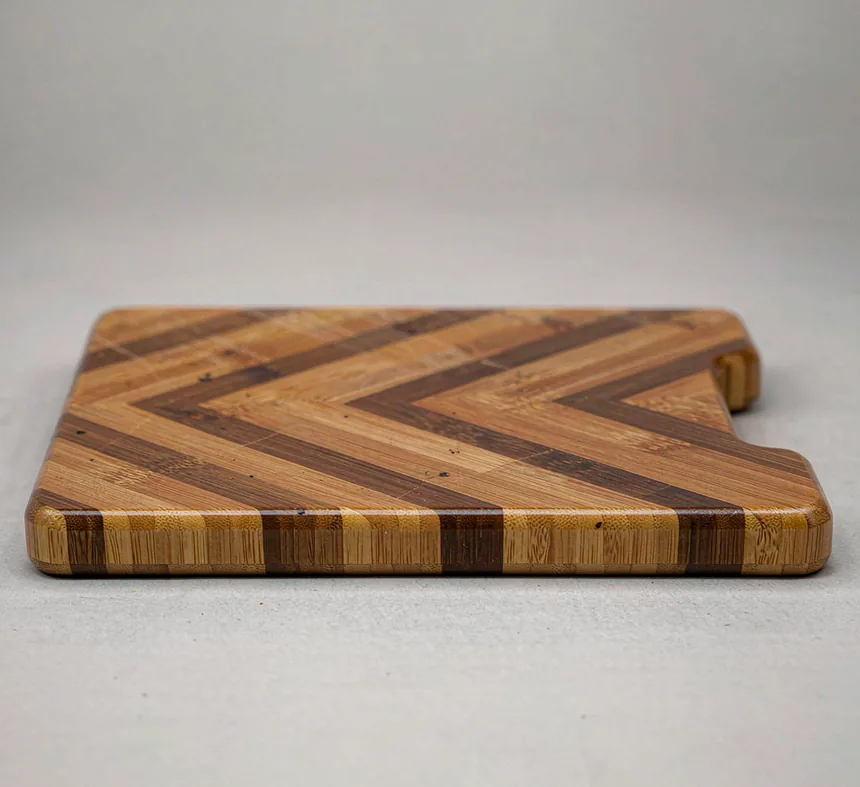
Every buyer asks for the MOQ. Almost nobody asks what the MOQ is made of. The number is not a policy — it is the point where the fixed costs stop dominating the unit price.
The fixed costs hiding in a quote
Take a simple laminated bamboo board with a laser logo and a printed sleeve.
- Setup and programming: CNC fixtures, laser files, print plates. One-off.
- Material buy: bamboo blocks are sold by the lot, not by the piece. A 300-piece run may still consume a full lot and leave offcuts.
- Packaging: sleeves and cartons have their own minimums, usually well above 300.
- Inspection and paperwork: the same per-shipment cost whether the container holds 300 or 3,000 pieces.
300 versus 3,000, roughly
At 300 pieces the fixed costs land on very few units and the price per piece can be 40–60% higher than at 3,000. At 3,000 the fixed costs are absorbed, the material buy is efficient and the freight per unit drops because the container is full rather than half empty.
Try 600 pieces and you get most of the packaging benefit and none of the freight benefit. The sweet spot is usually the point where the carton count fills a pallet cleanly.
The cheapest MOQ is the one that fills a pallet, not the one that fits your cash flow.
Where to negotiate instead of the MOQ
If 3,000 is too much for a first order, do not push the MOQ down. Push the packaging: plain sleeves for the pilot, printed sleeves on the repeat. Push the mix: two SKUs at 500 each often costs less than one SKU at 300, because the shared setup is amortised once.
And ask what the tooling charge is separately. A supplier who will not separate it is loading the number.
Next step
Send the spec. Get the price in 24 hours.
Tell us sizes, finish, quantity and packaging — we reply with a costed quote and a
sample plan, usually the same working day.